Fela Kuti and the Nigerian Left
By Sean Jacobs
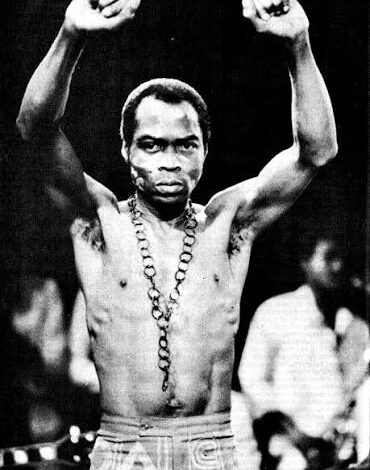
Recent major exhibitions, one in Paris in 2022 and another in Lagos in December 2025, as well as a Lifetime Achievement Award at the Grammys last month, cast Fela Aníkúlápó Kútì as a singular cultural icon, an eccentric genius or global rebel shaped by Pan-Africanism and the Black Atlantic, while downplaying how deeply he was formed by left radical currents in Nigeria.
Situating Fela in that left tradition clarifies the political stakes of his music and activism and restores the collective histories that animated his work. His political career unfolded when a distinctly Nigerian left – rooted in universities, trade unions and parts of the state – was at its intellectual and institutional height. His music, public persona and confrontations with military rule cannot be fully understood without reference to that history.
Ahmadu Bello University, a public university in Zaria, the capital of Kaduna State, may have been named after a conservative northern political leader but between the mid-1970s and late 1990s it was a major incubator of Marxist and socialist thought. The Jamaican sociologist Patrick Wilmot and the historian Yusufu Bala Usman were among those who taught there, helping to shape a generation of students for whom Marxism was not a marginal or clandestine doctrine but part of the formal curriculum. (Public events marking the recent death of Biodun Jeyifo, a prominent literature scholar and Marxist who will be buried next month in Ibadan, brought back memories of that period.)
In 1977, at the height of his fame, Fela attended the All-Nigerian Socialist Conference at Ahmadu Bello University with members of his band and dance troupe. (The mathematician and revolutionary socialist Edwin Madunagu later recalled that Fela and his entourage ‘insisted on sitting on the floor’.) Such encounters are rarely mentioned in biographies or critical accounts of Fela, yet they place him squarely inside Nigeria’s organised left.
Two years later Fela founded the Movement of the People (MOP). Its stated aims were to end military rule, corruption and neocolonial structures, but the project went further than conventional opposition politics. The MOP promoted Pan-African unity, economic self-reliance and a rejection of Western cultural domination. When Fela tried to run for president in 1979 his candidacy was declared invalid and the movement’s impact was largely cultural rather than electoral. (The MOP was recently re-established as a political party by one of Fela’s sons, Seun, a musician and activist.)
Despite their shared commitments, Fela’s relationship with others on the Nigerian left was contentious, and disagreements were often sharp. He criticised leftist intellectuals – many of them university academics – for supporting Nigeria’s corrupt political class through engaging in electoral politics, and for their uncritical reliance on Western Marxist frameworks to interpret African realities.
Ola Oni, who taught economics at the University of Ibadan, in turn criticised the MOP for advocating ‘tribal or racial socialism’. Fela’s reply, on MOP letterhead, was shared with me by the political researcher Sa’eed Husaini. Clearly influenced by Black nationalist thought from his time in the United States, Fela urged Oni to engage more deeply with this intellectual tradition and cited Walter Rodney’s How Europe Underdeveloped Africa (1972) as evidence of the ways slavery and colonialism had negatively shaped Africa’s development. Rather than importing orthodox Marxism wholesale, Fela argued that left politics in Africa had to be contextual: ‘Kwame Nkrumah is more relevant to us than Marx, Mao, Lenin or Castro.’ ‘African Unity gives us an indispensable nationhood,’ he wrote. ‘This is the highest stage of socialism, within the African context … Socialism and African Unity are organically complementary.’
Even though Nigeria had been ruled – with brief interruptions – by military regimes since the mid-1960s, leftist intellectuals exerted real influence in government. Some advised General Murtala Muhammed (1975-76) on foreign policy, including Nigeria’s leading role in the international isolation of apartheid South Africa. Nigeria was among the first countries where the banned African National Congress had an official presence. Until General Ibrahim Babangida (1985-93) constrained this activist foreign policy, Nigeria also backed liberation movements in Zimbabwe, Namibia and Portuguese colonies, and was a strong supporter of non-alignment.
In 1986, Babangida established a public commission, chaired by the historian Samuel Joseph Cookey, to ‘conduct a national debate on the political future of Nigeria’. Among its members were Madunagu and Pascal Bafyau, later president of the Nigeria Labour Congress. As the anthropologist Omolade Adunbi wrote in Africa is a Country in 2016, the Cookey Commission’s conclusions pointed towards social justice, a return to democracy and even the construction of a socialist state. These were also the themes animating Fela’s music during this period: the denunciation of military tyranny, exposure of class predation and an insistence that Nigeria’s crisis was structural rather than merely moral.
The regime rejected most of the commission’s recommendations and soon embraced an IMF austerity and liberalisation programme, but turned down the IMF loan package – opting for the side effects without the medicine – in a cynical bid to preserve an aura of nationalist self-reliance while signalling to private creditors that Nigeria had embraced economic orthodoxy.
Babangida combined this economic turn with an ideological purge, moving aggressively against the university and trade union left. ‘At Ahmadu Bello University, the military ordered all Marxist books burned and dismissed professors associated with Marxism,’ according to Adunbi. The Nigeria Labour Congress was formally dissolved by the military government in 1988 and later that year Patrick Wilmot was deported: abducted on his way to campus, dropped at the airport and put on a flight. He would not return to Nigeria until 2006.
State violence against Fela persisted throughout this period. In February 1977, a few months before the the All-Nigerian Socialist Conference, hundreds of soldiers raided the Kalakuta Republic, Fela’s compound in Lagos where he lived with his family and band members (it had a health clinic as well as a recording studio). His mother was thrown from a window and later died from her injuries. The compound was burned to the ground. In 1984 he was imprisoned for nearly two years. The parallel is not incidental: both Fela and the broader Nigerian left were targets of the same counteroffensive against radical criticism.
In 1993, Babangida was compelled, in the face of popular opposition, to concede to multiparty politics, even as he tried to stage-manage the transition. When the result went against him, he annulled the election. The victor – hailed as a proxy for liberal-left and progressive aspirations – was Moshood Abiola, a wealthy businessman whom Fela had already named, more than a decade earlier, as an ‘International Thief Thief’ for his role in the corruption of Nigeria’s public institutions.
As well as figures such as Madunagu, Wilmot and Usman, Fela’s politics were indebted – more intimately still – to the radical example of his mother. Funmilayo Aníkúlápó Kútì was an anti-colonial activist, a feminist organiser and a recipient of the Lenin Peace Prize, awarded in recognition of her leadership of the Abeokuta Women’s Union and her advocacy for women’s rights. Fela was immensely proud of her. He once told a crowd:
Now there’s not been anybody in this whole politics in Africa – only two people have worked on the streets to follow people to where they are going: Nkrumah and my mother. What are you talking about? All this nonsense that you have hanging around here – they sit down in cars, man. This government threw my mother out of a window. Mrs Funmilayo Aníkúlápó Kútì, who fought with her blood for this country on the streets.
Kwame Nkrumah met her in 1957 during a visit to Nigeria, and there are accounts from the Kútì family of Fela accompanying her to that meeting. Three decades later, in 1987, Fela encountered another emblematic figure of African revolutionary politics, Thomas Sankara, while attending a film festival in Burkina Faso. Sankara, the Pan-Africanist and leftist head of state, was assassinated soon afterwards.
Fela did not invent his antagonism toward the Nigerian state out of thin air. He gave sound, spectacle and mass resonance to an existing critique that was also being elaborated in lecture halls and union offices across the country.
In the end, the messianism and machismo of Fela’s persona overshadowed his militancy and his connections to both the Nigerian and the broader African left. Some Nigerian leftists have argued that he flirted with an authoritarian strain of Pan-Africanism, embodied in his admiration for Nkrumah (who was eventually overthrown in part because of his rising authoritarianism), which helps explain why he didn’t join any formal left organisation beyond his own party. Over time, Fela came to be remembered not only for his musical innovations but also for his Aids denialism. In some respects, this was a product of its time, but it was nonetheless deeply reactionary.
Fela died in 1997. His brother, Olikoye (‘Koye’) Ransome-Kuti, a medical doctor, announced shortly after his death that Aids-related illness was the cause. Some of Fela’s children initially opposed making this public, but eventually came around. After his death – despite his denialism in life – Fela’s body became a vehicle once again for a progressive public message.