
Research shows vegetables, tomatoes you eat may be poisons
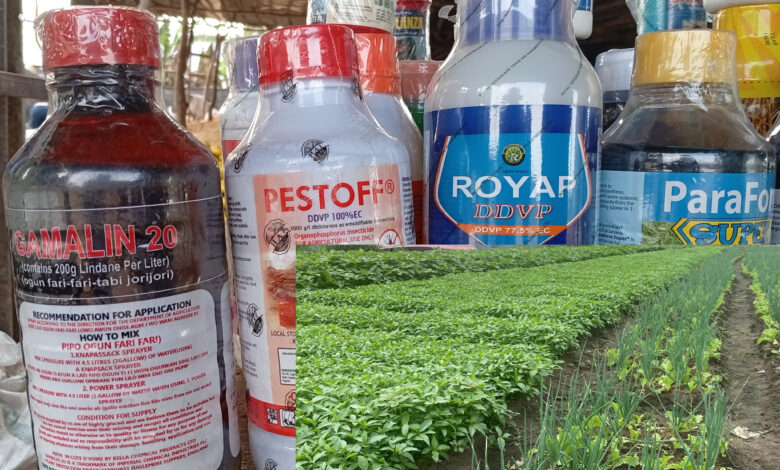
Findings indicate presence of banned chemicals in fruits and vegetables markets in Nigeria
By Samuel Ogunsona
Many fruits and vegetables you eat in Nigeria is like taking a routine of poisons, research has shown.
Investigations conducted by our correspondent has revealed the presense of banned chemicals like organochlorine pesticides in fruits in Nigerian popular markets. This has raised concerns about the increasing risks of cancer and other diseases.
Many of these chemicals have been banned since 2008, due to their potential health effects but were discovered to be active in Nigerian agro products indicating a regime of weak institutional control.
Extensive lab tests reveal the presence of several such harmful substances in soil, vegetable and soil animal samples taken from a popular farm in Lagos.
Farmers interviewed for this story say they use organochlorine pesticides, which are sold in the local market.
Recent research points to the need for greater education among Nigerian farmers, as many are misusing pesticides (including banned chemicals), applying them without protective gear and suffering health effects from these substances.
Experts emphasize the importance of adopting sustainable agricultural practices, such as integrated pest management (IPM), climate-resilient agriculture and agroecological practices to reduce dependency on synthetic pesticides and to promote soil health.
The sun rises over lush farm fields of on the outskirts of Lagos. For more than 20 years, a farmer named Joe has tilled the land, coaxing life from the earth and reaping bountiful harvests. But here, beneath the surface of this idyllic scene, lies a complex web of challenges — chief among them, the relentless threat of pests. Joe’s story is one of trial and error, of desperation and loss, and of the unintended consequences of relying on chemical pesticides.
“I planted scent leaf [African basil] on my farmland, it started germinating … that was the beginning and first time planting such seedlings, so I didn’t know how tough it could be,” Joe recalls, his voice laced with a mix of frustration and resignation while speaking to Mongabay. He notes an abundance of aphids and caterpillars on his plants, which present a constant challenge.
“I came to my farmland one fateful morning and I saw a lot of insects flying around my farm,” he says. “They have taken over my scent leaf. That incident resulted in total loss of my investment because no one could buy that produce.”
That experience marked a turning point in his farming career. Desperate to protect his livelihood, Joe turned to chemical pesticides, convinced they held the key to safeguarding his crops.
But the pesticides that promised to save Joe’s crops have become a double-edged sword for him. The substances he used are called organochlorine pesticides, which have been linked to soil degradation, the decline of beneficial soil animals and even distortion of soil formation. These chemicals, designed to kill pests, can also harm humans and wildlife, contaminating water sources and food chains.
Joe shakes his head, recalling a disastrous day. “I had a batch of scent leaf ready to sell, and a customer promised to buy them all the next day. In my excitement, I decided to give them a little extra care with a heavy dose of pesticides to keep those pests away. I thought I’d be a hero, but it turned out to be a poisoned chalice. The chemicals ended up burning my entire scent leaf [crop]. I lost all my market and was left indebted.”
When asked what might have caused the damage, Joe replies with a wry smile, “Overuse of pesticides, no measurements. … I only meant to send a signal to the pests, but it seems the signal was more like a death sentence for my vegetables.”
Joe tells Mongabay that he uses Gammalin, which contains the ingredient lindane and has been banned in Nigeria for years due to its high toxicity and environmental danger. He admits that these pesticides can have significant health effects.
“These are powerful chemicals — we need to protect ourselves 100% to avoid skin contact with these chemicals; the smell of the chemicals are also poisonous,” Joe acknowledges.
The farm, which spans several acres, is a major supplier of vegetables to popular local markets, with produce ranging from scent leaf (Ocimum gratissimum) to various leafy greens. Joe confirms that it is common for local farmers to use chemical pesticides on their crops, which are then sold in large quantities to markets across the city. However, Joe doesn’t disclose where he buys organochlorine pesticides, which he says he and other farmers in the area have used on their crops.
Joe’s story illustrates a widespread public health problem, as pesticides deemed unsafe in many countries continue to surface on farms across Africa — and Nigeria in particular. Recent research points to the need for greater education among Nigerian farmers, as many are misusing pesticides (including banned chemicals), applying them without protective gear and suffering health effects from exposure to these substances.
Joe’s experience is what prompts our investigation into soil quality and potential contamination risks associated with prolonged organochlorine pesticide use. Our reporting includes testing samples of soil, soil animals and vegetation from Joe’s farmland, which has widespread reach. The results confirm the presence of several pesticides banned 17 years ago in Nigeria — including lindane, the substance Joe has used. Although found in “negligible” amounts in the soil samples tested, these results raise questions about pesticide use in the area — and the health and safety of farmers, the environment and the produce that people eat.
Toxic legacies
“The history of life on earth has been a history of interaction between living things and their surroundings. … If we are going to live so intimately with these chemicals eating and drinking them, taking them into the very marrow of our bones — we had better know something about their nature and their power.” — Rachel Carson, Silent Spring.
A lot of work has been done on the use of pesticides and their effects on the environment, much of it inspired by a wake-up call from Rachel Carson’s groundbreaking book, Silent Spring. Carson documented the environmental harm caused by the indiscriminate use of DDT, a form of organochlorine pesticide widely used during World War II. She accused the chemical industry of spreading disinformation and public officials of accepting their claims without scrutiny, bringing attention to the need for responsible use of pesticides.
Carson’s work was instrumental in raising public awareness about the dangers of pesticides and sparking an environmental movement. Her book led to a nationwide ban on DDT for agricultural uses in the U.S. and paved the way for the creation of the U.S. Environmental Protection Agency. Since then, numerous studies have built upon Carson’s work, further highlighting the risks associated with pesticide use and the importance of sustainable practices.
However, today, dangerous pesticide contamination still persists in many regions — including Nigeria.
In order to determine the extent of pesticide contamination on Joe’s farm, Mongabay enlisted the services Onafowokan Olayinka Kehinde, a Lagos State University laboratory scientist; and Patrick Onianwa, a technician at ISI Analytical Laboratory in Surulere, Lagos, where the samples are analyzed.
Kehinde collected soil, soil animals (earthworms, Lumbricus terrestris) and leafy vegetables (Celosia argentea) from the farm, following standard protocols (witnessed by Mongabay). The samples were collected around 8 a.m. Aug. 28, placed in sterile containers, labeled and stored in a cool box with ice packs to maintain a temperature of approximately 4° Celsius (39° Fahrenheit). The samples were then transported to ISI Analytical within two hours of collection.
Out of 24 pesticide compounds analyzed, the earthworm samples revealed the presence of 11, the soil samples had 11 and the vegetable samples indicated the presence of four.
Lindane, heptachlor and aldrin were found in all samples tested (soil, animal and vegetable), while endosulfan and endrin were also found in some of the samples. These five substances are organochlorines, which research ties to “high toxicity, slow degradation and bioaccumulation.” All five substances are banned for agricultural use in Nigeria. They are also banned, widely restricted or slated for elimination in the U.S., EU, Japan and other regions due to their environmental persistence and potential health risks.
According to Victor Kusemiju, a senior lecturer in zoology and environmental biology at Lagos State University, “Organochlorine pesticides persist in the environment for a long time, remaining effective for years after application. Unlike other pesticides, they break down slowly. They are also non-selective, killing a wide range of pests and non-target organisms, including fish, wildlife — and potentially humans if exposure levels are high enough.”
30 pesticides banned in Nigeria — but some still used
In 2008, Nigeria’s National Agency for Food and Drug Administration and Control (NAFDAC) released an official list of 30 banned pesticides, including the five specified above. According to local reports, the bans were part of a broader effort to prohibit hazardous substances linked to health issues, including food poisoning deaths.
Our investigation sheds light on the reasons why, then, these compounds still appear in the environment. Another farmer working in fields close to Joe’s tells Mongabay that he uses Gammalin pesticides, but that he had no prior knowledge of the ban. The farmer wishes to remain anonymous due to security reasons, but his story prompts us to probe further, going into three local markets where we find Gammalin for sale — including one market with the product openly visible on the shelf.
That particular market seller says they were unaware of the ban on Gammalin, and also that the product is scarce in the market, which has driven up its price. A 1-liter (0.3-gallon) bottle used to sell for 4,000 naira ($2.75), but the price has increased to 10,000 naira ($6.90), reduced to 9,000 naira ($6.20) after negotiation.
The accessibility of these chemicals in local markets allows farmers to find ways to acquire and introduce them into the environment, undermining efforts to protect public health and ecosystems.
The continued presence of these substances in the environment — and the market — also raises questions about the effectiveness of Nigeria’s pesticide bans.
Mongabay has reached out to NAFDAC multiple times via email, seeking information on the effectiveness of the lindane ban and its current sales status, but we have not received a response by the time of publication.
Ogunlade Olamide Martins, associate director of climate and environment at Corporate Accountability and Public Participation Africa, tells Mongabay about some of the major factors contributing to the persistence of these substances. “Banned pesticides continue to find their ways to the local markets due to the porosity of our borders and poor enforcement strategies,” Olamide says. He also notes “the absence of dialogue between policymakers and the actors where progressive phaseout strategy and synergy among critical monitoring stakeholders would have been exhaustively discussed.”
Olamide says all of this reflects “the absence of political will and the limitations of responsible agency to deliver on its enforcement mandate either due to technical incapacitation or bureaucratic bottlenecks. … One cannot also completely rule out the likely influence of pesticides-importing entities in delaying enforcement,” he adds. “To improve compliance, the government must initiate a special task force drawn from relevant security agencies to launch and sustain coordinated investigations, with officers trained in best practices and standard operational procedures.”
Director of programs at Health of Mother Earth Foundation, Joyce Brown, responds with urgency. “The government must enforce strict policies and surveillance to remove banned pesticides from the market immediately,” she tells Mongabay in an interview. “There’s no room for a gradual phaseout of highly hazardous chemicals – they should be taken out of circulation now.”
Hidden dangers
Lindane has been classified as “carcinogenic to humans” by the World Health Organization’s International Agency for Research on Cancer (IARC), with evidence linking it to non-Hodgkin lymphoma. The IARC notes that current general population exposure to lindane is mainly through diet or when used as a treatment for scabies or lice.
Kusemiju, the LASU senior lecturer, raises another issue with these substances: “One of the most concerning aspects of organochlorine pesticides is their ability to harm non-target organisms that play crucial roles in maintaining ecological balance,” he says. “For instance, earthworms are vital for soil health, as they contribute to soil formation, aeration and nutrient cycling.
“Moreover, when heavy rainfall occurs shortly after the application of these pesticides, the chemicals can be washed away and transported into nearby water bodies, such as rivers, lakes or oceans. If the pesticide concentration is high enough, it can be toxic to aquatic organisms, leading to unintended and potentially devastating effects on aquatic ecosystems,” he says.
Ikechi Agbugba, a distinguished agricultural scientist and entrepreneur with expertise in agribusiness management, agricultural education and sustainable development, underscores Kusemiju’s concerns. He provides Mongabay with a tally of problems related to organochlorine pesticides: “Degradation of soil structure: OCPs reduce soil aggregation; disturbance of soil microbial communities: high levels of OCPs are toxic to beneficial soil microorganisms; reduction in enzymatic activity: OCPs can inhibit these enzymes (like dehydrogenase, urease, phosphatase, and cellulase), leading to slower organic matter decomposition and reduced nutrient availability for plants.”
He says organochlorine pesticides can have devastating effects on soil fauna populations, leading to “slower decomposition, reduced microbial interactions, poor soil structure [and] disrupted food webs.”
He particularly emphasizes the significance of earthworms. “They are part of the ecosystem of the soil.” Soil animals overall play a crucial role in maintaining soil health through decomposition, nutrient cycling and soil structure formation, he says. “Earthworms, nematodes, mites, springtails, ants and beetles are critical to maintaining healthy soils,” Agbugba says. “They are often referred to as ecosystem engineers because of the key roles they play in decomposition, nutrient cycling, soil structure formation, and even plant health.”
Meanwhile, Ogunrinde, a farmer and agrochemical expert with Ogunrinde Agrochemical, points to yet another issue: “The biggest problem is that our environment has changed, the climate has changed a lot of things and the kind of seeds we plant now is also different from those planted 50 years ago,” he says. “Most of our seeds now are GMO, inorganic seeds. They are seeds that are produced in the labs and … they are prone to pests, unlike the natural seeds,” he tells Mongabay via audio.
He notes that pesticides are often the most effective way to control such pests — but he acknowledges the risks associated with their use. He suggests a potential solution to help reduce pesticide use: producing seeds resistant to pests. “I believe it is possible to produce seeds that pests can stay away from,” he says.
Agbugba, meanwhile, recommends a more holistic approach, suggesting that farmers adopt integrated pest management, known as IPM, which combines biological, cultural, physical and chemical tools to manage pests. According to him, farmers can adopt a variety of practices, including biological controls (using natural enemies of pests such as predators, parasites or pathogens), crop diversification and rotation (rotating crops disrupts pest life cycles and reduces buildup of soil-borne diseases).
Farmer education is also key. “In the olden days,” Kusemiju says, Nigerian government representatives would educate farmers, telling them “what type of pesticides to use, what concentration to use and also when to apply these things.” But now, he says, “those things are not happening.”
Sustainability and food security
Experts agree that sustainable agricultural practices are crucial for ensuring food security. “Policymakers should strengthen climate-resilient agriculture,” Agbugba says, by promoting agroecological and regenerative practices such as minimum tillage and more mulching to help restore soil health, enhance biodiversity, and reduce the use of synthetic pesticides. Other ideas include climate-smart technologies such as drought-resistant crops, precision irrigation and early warning systems for weather and pest outbreaks.
Agbugba notes soilless farming as a sustainable option for food production with a lower environmental impact. “Soilless systems can be set up in urban areas, rooftops or indoors, bypassing the need for fertile land,” he says, adding that policymakers should invest in “farm to fork” food systems and enforce regulations that “protect natural resources and human health.”
The list of potential solutions is long.
However, Joe’s worrying experiences with organochlorine pesticides — including the devastating loss of his scent leaf crops due to overuse and improper application — indicate just how much work remains to be done.
Source: Mongabay
Note: This investigation was sponsored by Mongabay media.
Citations:
Jayaraj, R., Megha, P., & Sreedev, P. (2016). Review article. Organochlorine pesticides, their toxic effects on living organisms and their fate in the environment. Interdisciplinary Toxicology, 9(3-4), 90-100. doi:10.1515/intox-2016-0012
Zhou, W., Li, M., & Achal, V. (2025). A comprehensive review on environmental and human health impacts of chemical pesticide usage. Emerging Contaminants, 11(1), 100410. doi:10.1016/j.emcon.2024.100410
Taiwo F. Akinyanju, Fidelia Osuala, Abiodun Onadeko, Nnamdi H. Amaeze, & Olukunle S. Fagbenro. (2025). Pesticide application practices and environmental implications: Insights from farmers in Lagos state, Nigeria. Dutse Journal of Pure and Applied Sciences, 11(3c), 64-79. doi:10.4314/dujopas.v11i3c.7
Okewole, S.A., Rafiu, R.A., & Amusat, M.A. (2023). Overview of pesticide usage, misuse and its impact on environmental degradation in south-western states and some part of northern states in Nigeria. Pesticide Science and Pest Control, 2(1). doi:10.58489/2833-0943/013