In Memory Prof Biodun Jeyifo, my teacher
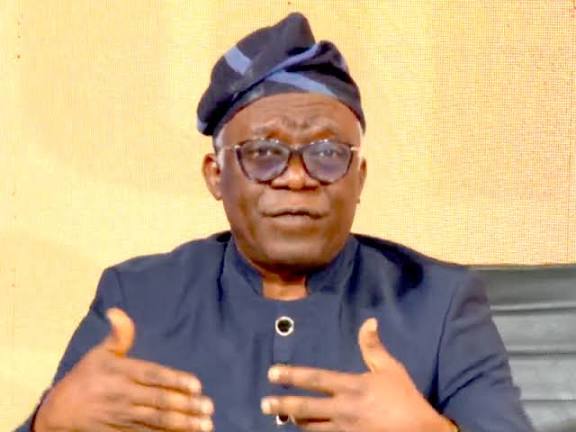
By Femi Falana SAN
Following the commercialisation of tertiary institutions in 1978 by the Olusegun Obasanjo military junta at the behest of the World Bank, Nigerian undergraduates embarked on a boycott of lectures and street protests. The violent disruption of the peaceful protests by the police led to the brutal killing of some students at the University of Lagos and Ahmadu Bello University. The federal government instituted the Usman judicial commission to probe the crisis. At the end of the inquiry, the vice chancellor of ABU, Professor Iya Abubakar was forced to resign by the Supreme Military Council while Professor Ade Ajayi, the Vice Chancellor of the University of Lagos was sacked for attending the burial of Akintunde Ojo, one of the slain students, at the Atan cemetery in Lagos.
In a bid to deradicalise the campuses, some marxist lecturers including Comrade Ola Oni, Bade Onimode, Omafume Onoge and Akin Ojo of the University of Ibadan, Eddie and Bene Madunagu of the University of Calabar, Laoye Sanda of the Ibadan Polytechnic and Ebenezer Babatope of the Yaba College of Technology, Lagos were dismissed. Owing to the principled stand of the management of ABU and Unife at the material time, the many marxist and radical lecturers in both institutions escaped the purge.
As a law student at the University of Ife (now Obafemi Awolowo University), Professor Biodun Jeyifo (BJ) did not teach me in the classroom. But as one of the staff advisers of the Alliance of Progressive Students (ALPS), a student socialist body in the campus, BJ was our mentor. As a fresh law student, I visited him in his office sometime in 1978. In the course of our discussion, BJ made me realise that “even though the law is an instrument of oppression in every class society, it can be turned into a liberating tool.” He recommended to me a number of books on marxist jurisprudence. I read them, and we later discussed them. Although BJ described himself as a layman, he addressed the topic of our discourse like a learned gentleman!
During the 1979/80 academic session, I served as the public relations officer of the student union of the University of Ife (now Obafemi Awolowo University). The union president, Mr. Wole Olaoye was BJ’s student. Since Wole had great admiration for him, BJ became our adviser based on his rich experience as a former student leader at the University of Ibadan. Both Wole and I were delighted when Dr. Biodun Jeyifo was elected the National President of the Academic Staff Union of Universities (ASUU) in 1980.
With the encouragement of BJ and other progressive lecturers, we decided to resuscitate the NUNS. We rejected the plan of the federal government to lift the proscription of NUNS and have it run like a parastatal under the federal ministry of education. We rejected the conditionality inaugurated the National Association of Nigerian Students (NANS) on December 10, 1980. The ASUU recognized the NANS and met its newly elected leaders. The student leaders sought the support of ASUU in ensuring the recall of student activist leaders who had been expelled for mobilising students to resist the unlawful control of student unions.
Upon BJ’s request, the NANS leaders furnished him with the list of the expelled student activists. To the credit of ASUU, the dismissed lecturers and student activists were recalled by the Shehu Shagari administration. Thus, in 1980, former NUNS President, Segun Okeowo, who had been expelled at the University of Lagos, was admitted at Unife, where he completed his course. In 1982, Isa Aremu, Bala Mohammed and Chom Bagu who had been expelled at the Ahmadu Bello University by Professor Ango Abdullahi were admitted to the Universities of Port Harcourt, Lagos and Jos where they eventually graduated.
On the campus, the Unife student union worked with the local chapter of ASUU. In particular, we jointly organised programmes including the two memorial lectures in honour of Dr António Agostinho Neto who served as the first president of Angola from 1975 to 1979, after leading the Popular Movement for the Liberation of Angola (MPLA) during the war for independence and had died of cancer and Dr. Walter Rodney, who was killed by a remote-controlled explosive device planted in his car in Guyana on June 13, 1980. The deceased had become popular in the university community in Africa on account of his book entitled “How Europe Underdeveloped Africa.”
As a result of the 1978 restructuring of the labour unions, the ASUU was registered as a trade union. It was under BJ’s leadership that ASUU became the intellectual wing of Nigeria Labour Congress. He repositioned ASUU to fight for improved working conditions for the academic and non-academic staff in all universities in the country. It is on record that BJ succeeded in laying a solid foundation for ASUU because he enjoyed the maximum cooperation of the Socialist Forum constituted by Dr. Segun Osoba, Toye Olorode, Idowu Awopetu, Dipo Fasina, G.G. Darah, Biodun Jeyifo, and other members.
As a columnist in some newspapers, BJ regularly consulted me with a view to avoiding a conflict with the law of libel. He also wanted to ensure that his views on certain aspects of the anti graft laws were accurate. I once threatened to charge him professional fees for the consultations. But BJ quickly reminded me that upon the receipt of my bill of charges, he would file a counter claim since I had once said, in a public programme, that he and other members of the Socialist Forum were my external lecturers in my undergraduate days at Ife.
A couple of months ago, I attended the ceremony held in Lagos to mark the 80th birthday of BJ. It was put together by his comrades and former students. BJ was full of gratitude to the organisers of the event and the many admirers who had converged to honour him in his lifetime. In his memorable speech on the occasion, he said that abundant evidence had proved, over and over again, that capitalism could not save humanity. He therefore charged his comrades to intensify the struggle for the socialist transformation of the world.
With respect to Nigeria, BJ urged Nigerians to demand the urgent actualization of the fundamental objectives and directive principles enshrined in chapter two of the nation’s bourgeois constitution. He was, however, elated when I disclosed that the ruling class had been compelled to enact a number of laws for the actualization of the fundamental objectives. As I bid him farewell at the end of the programme, BJ tasked me to make the welfare laws available to the trade unions to enable them to demand their implementation to prepare them to pave the way for the establishment of a society that is solidly erected on the foundation of social justice.