Journalists urged to report climate change Impact on Abuja Indigenous people
By Samuel Ogunsona
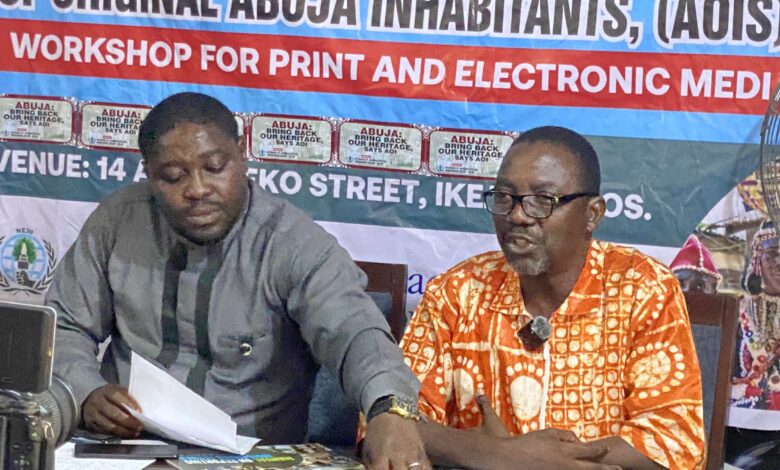
Media participants at a conference in Lagos have called for greater attention to the plight of Abuja Original Inhabitants, (AO1s).
The Network of Journalists on Indigenous Issues, (NEEJI) which organised the conference called on Federal and regional authorities to take proactive measures against the growing impact of climate change on Abuja’s indigenous communities.
The call was made on Tuesday, June 3, 2026, at a one-day media parley in Lagos themed ‘50 Years After Abuja: Climate Change and Livelihood of Abuja Original Inhabitants’.
NEJII warning that 50 years after the creation of the Federal Capital Territory the original inhabitants are bearing the brunt of environmental shifts.
The workshop was organised by NEJII in collaboration with the Resource Centre for Human Rights and Civic Education and supported by the MacArthur Foundation.
Media trainer and paper presenter Fabian Anayo told journalists that reporting on Indigenous peoples requires cultural sensitivity, accurate terminology, and ethical storytelling.
He said reporters must avoid harmful stereotypes and extractive practices by prioritizing informed consent and using specific nation names rather than broad labels.
“Reporting on Indigenous peoples requires cultural sensitivity, accurate terminology, and ethical storytelling,” Anayo said.
“To avoid harmful stereotypes and extractive practices, prioritize informed consent, use specific nation names rather than broad labels, and portray communities with multidimensional dignity rather than focusing solely on trauma or victimization.”
He advised journalists to clearly explain their focus, intent and publication platform before interviews, and to respect cultural protocols especially around traditional knowledge, sacred spaces, shrines and restrictions on photographing deceased persons. Anayo also urged reporters to learn the local context, understand history, governance and current issues, and to build relationships with communities before news breaks.
“Build relationships before you need a story. Trust develops over time,” Anayo said. He added that journalists should prioritize Indigenous voices over outside experts, avoid deficit-only narratives, and include stories of innovation, leadership, culture, education and business alongside challenges.
Anayo stressed the importance of understanding sovereignty and governance, noting that many Indigenous nations have their own governments, laws and political structures that deserve the same seriousness as other governments. He asked reporters to verify terminology preferences, as language varies across communities, and to respect restrictions on ceremonies, sacred sites, stories and images.
“Be careful with trauma reporting. Stories involving violence, displacement, missing persons or historical injustices require extra care. Avoid sensationalism and consider how reporting may affect survivors and families,” Anayo said.
NEJII has called for historical context in every story, saying current events on land, natural resources, language and legal disputes cannot be understood without background.
On narrative framing, organisers urged journalists to decolonize their approach and resist extractive journalism.
“Decolonize Your Narrative: Resist extractive journalism where outside reporters take stories from marginalized communities without providing reciprocal value or context. Strive to show Indigenous peoples as multidimensional—highlighting their leadership, arts, and activism alongside challenges,” NEJII mentioned.