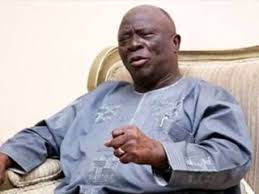
Nigeria: Restructuring is too late, Yoruba Nation Now Akintoye insists
By Gbile Oshadipe, PhD
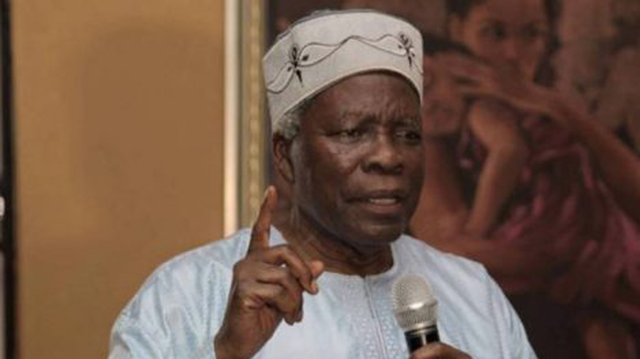
At the town hall meeting of the Yoruba Nation on Thursday 10 September, 2026 titled “The Realities of Nigeria: Any Hope for the Yoruba Nation,” the leader of the Yoruba Self Determination Movement, Professor Steven Adebanji Akintoye has insisted that Nigeria has gone beyond restructuring or reverting to regionalism. The erudite Professor of History and acclaimed scholar notes that “we once had a region until 1962 when it was snatched from us.” Here he was referring to the Yoruba peoples’ experience in the First Republic, when a particular region dominated the others.
Going back into Nigerian history, Akintoye, the leader of the Yoruba Nation notes that staying with the present political contraption is like going backwards; to a time when the British colonial administrators and their collaborators created a problem of inequality between the regions, saying that Chief Obafemi Awolowo was too rigid, and that they would rather work with Chief Ladoke Akintola. That was when the Fulani hegemonists turned against the Yoruba, promising power and money to collaborators to truncate regionalism. It was part of the calculations of the British colonialists to make sure Chief Awolowo was not accepted into the Executive arm of the newly independent Nigerian government.
When asked whether the aspirations for the Yoruba Nation still stands, especially with the recent moves by the incumbent President, Asiwaju Bola Ahmed Tinubu’s move to restructure the Nigerian federation into six units, Prof. Akintoye reveals that the Yoruba people do not want a “Western Region” within Nigeria, but a sovereign Yoruba Nation which will be an independent homeland of the Yoruba.
The one time associate of the sage, Obafemi Awolowo appreciates the rebirth of the Yoruba spirit and desire for a modern social, cultural and political entity; with freedom to “freely determine their political status and pursue their economic, social and cultural development.” This is the right to maintain and strengthen their distinct political, legal, economic, social and cultural institutions” outside the ambit of Nigeria. This is guaranteed under the United Nations Declaration of the Rights of Indigenous Peoples adopted on June 29, 2006 at the inaugural session of the United Nations Human Rights Council.
Akintoye expresses his appreciation for the Yoruba traditional leaders and potentates who are gradually waking up to the Yoruba Nation ideals. He lauded, especially, the trail-blazing role of Oni of Ife, Oba Adeyeye Enitan Ogunwusi, Ọjájá II for his support of the Yoruba cause with his donation of a Toyota Hilux four wheel drive and N100 million to the pan-Yoruba security outfit, Iruekun in its quest to protect Yoruba people and the territorial integrity of Yorubaland against banditry and Fulani insurgency and expansionalism.
When he was asked whether the Yoruba Nation aspiration is still achievable, Prof. Akintoye enthuses that: “Yoruba Nation is stronger today than any time before.” But he is quick to point out that Yoruba Nation is not at war with any group, although, according to him: “ we are no longer willing to remain in Nigeria.
Our struggle for the liberation of Yoruba Nation is much stronger than before.” To further buttress his argument, the world acclaimed scholar and author of A History of the Yoruba People; and Revolution and Power Politics in Yorubaland, 1840 – 1893: Ibadan Expansion and the Rise of Ekitiparapo went back into the history of the Yoruba Nation, stating that: “what the Fulani has been doing to the Yoruba people has made the Yoruba to understand the issue.”
And what are the issues? This is the neo-Caliphate expansionism targeting land grab and the pacification of all Nigerian communities, which is a new Fulani invasion tailored to fulfill the Uthman dan Fodio jihad of 1804, an ambitious quest to conquer all territories that is now known as Nigeria.
The defeat of the Sokoto Caliphate warriors by the Oyo/Ibadan army at Osogbo in 1840 effectively brought an end to the Fulani expansionism. But the troubling trend is that a new Fulanization agenda is backed up with assault weapons, kidnappings, terrorism and the ‘scorched earth’ tactics, otherwise identified as a deliberate Islamization agenda, spearheaded by the armed Fulani herdsmen and insurgents, Boko Haram insurgents and Islamic State of the West Africa Province, ISWAP, among others.
At the town hall meeting, attended by prominent elders and youths across the globe, Yoruba people were enjoined to wake up and take possession of their future. One such elder, Prof. Solomon Salako notes that the United Nations Declaration on the Rights of Indigenous Peoples guarantees the right of the people to freely determine their political status and freely pursue their collective rights, to fully enjoy all human rights and fundamental freedoms, as recognized in the Charter of the United Nations: the right to be free and equal to all other peoples and individuals, and be free from any kind of discrimination. By these rights they can freely determine their political status and pursue their economic, social and cultural development. He submits that the Yoruba people know what is going on. That the experiment called Nigeria is disintegrating while the cracks are visible. He notes that the very premise of the Constitution of the Federal Republic of Nigeria 1999 (as Amended) starting with “We the People…” is a fraudulent document because there was never a time the people invested it with authority, but was an imposition of then military dictators.