NDIGBO perception of Anioma and Second class citizens
Part One
Nwankwo T. Nwaezeigwe, PhD October 1, 2026
Odogwu of Ibusa
Apparently sponsored by confused Igbo political conmen masquerading as leaders, in their bid to intimidate Anioma people into accepting their fictitious Igbo Region or Biafra, some Igbo social media mad-dogs came howling, saying that any Anioma indigene who refuses to accept their Igbo ethnic nation should vacate his hometown and join Edo people in Edo State, because to them Anioma land belongs to Ndigbo Southeast.
There have also been multiple cases of many Southeast Ndigbo morons mocking Anioma people that they have already purchased their land from Niger Head Bridge to Issele-Azagba Express Junction, thus hazarding ancestral claim over the entire Delta State Capital Territory.
But the fact remains that the purchase of traditional land does not grant the purchaser the right of citizenship of the State or automatic indigene of the State. The Federal Republic of Nigeria Land Use Act 2004 defines such purchases as “Rights of Occupancy” which can be revoked by the State Governor at any moment.
Ironically, this is taking place even before Anioma people accept the proposed relocation of their proposed Anioma State to Southeast Geopolitical Zone, or inclusion in the proposed unviable and unworkable Igbo Ethnic Region. Think of what would then be the situation if any of the above political unification projects eventual materializes. Anioma people would become tenants in their own ancestral land.
There is no questioning the fact that this is ethnic familiarity gone too far. Let us not believe that these are not the kind of utterances that resulted to the Abandoned Property policy of Rivers State Government against their erstwhile Eastern Region Kinsmen.
Let us equally believe that these kinds of disreputable utterances are not the reason for anti-Igbo outbursts in Lagos State by Yoruba indigenes.
Leaders of Ndigbo Southeast should call their mad-dogs to order. Political unity in this modern age cannot come by the force of abuses, insults and attempts to distort other people’s traditional history, their time-honored customs and tradition, and reckless disregard of their value system.
Every individual or group has the right to define or redefine his identity. Language commonality alone does not define common ethnic ancestry or identity and so cannot form the basis for political unification.
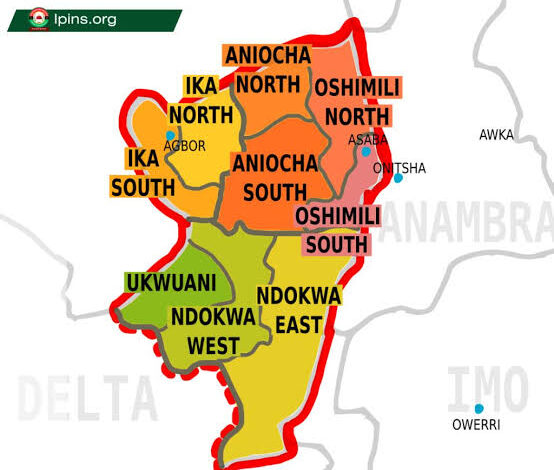
Anioma people have plethora of reasons why the demanded for political unification with Ndigbo Southeast is unworkable. Anioma is a multiethnic and geopolitical entity made up of Igbo, Bini, Esan, Igala, Yoruba, Urhobo, Isoko and Ijaw ethnic groups. Igbo language might be the lingua franca unifying these diverse groups as means of general communication, but such languages as Igala, Yoruba, Isoko, Esan, Bini, Urhobo and Ijaw are spoken as mother languages by various communities alongside Igboid languages.
It is ridiculous therefore that outsiders would attempt to impose a blanket Igbo ethnic identity on all these diverse ethnic groups for selfish political objective.
Beyond this fact of ethno-historical incompatibility, are moral questions arising from successive interactions between Anioma people and the Igbo of Southeast. While Anioma people have always treated the Igbo of Southeast with a sense equality driven by sincerity and large-heartedness, the reverse has aways been the case when it comes to the Igbo of Southeast dealing with Anioma people.
To Ndigbo Southeast, Anioma people are second-class Igbo people whose ethnic identity requires not only historical scrutinization but legitimization by them. In other words, to Ndigbo Southeast, if an Anioma man proudly identifies himself as Igbo, he does that not because he is proud of his identity but because he wants to belong to the class of people who see themselves as the higher breed of Igbo ethnic group.
To Ndigbo Southeast therefore, the core definition of Igbo interest does not equate with the collective interests of all the people speaking Igbo and related languages, but what they as the high-breed section of Igbo ethnic group consider as their core group interests.
Ndigbo Southeast are now disturbing the peace of these same second-class Igbo groups in South-South Geopolitical Zone with their quest for a fictitious Igbo unification project as propounded earlier by Nnamdi Kanu and his Indigenous Peoples of Biafra (IPOB) for their greater Republic of Biafra, because of the fear of being isolated in a land-locked over-populated, largely unfertile and obviously underdeveloped enclave in the event of Nigeria breaking up.
This explains why over-night Anioma people became full-baked Igbo people whose proposed State should form the sixth State of Southeast Geopolitical Zone.
But Anioma people with their previous experiences with Ndigbo Southeast know that whatever ethnic unification Ndigbo Southeast are driving are fictitious ventures designed to achieve their self-centered interests and not out of love of common ethnic identity or similarity in language. The following episode will confirm this heinous hypocrisy of Ndigbo Southeast towards Anioma people.
In 2015 Prof Gregory Ibe the founder and Chancellor of Gregory University, Uturu Abia State in coordination with other prominent Igbo leaders, convened and eventually founded World Igbo Summit Group (WISG), with Uturu as the Administrative and Coordination Center. It was a group composed of la crème de la crème of Ndigbo far above the rag-tag structurally defective Ohaneze Ndigbo. Anioma was represented by Col Joe Achuzia, Prof Pat Utomi, Prof Epiphany Azinge, SAN, later Asagba of Asaba, and myself Dr. Nwankwo T. Nwaezeigwe.
Major General Ike Nwachukwu (rtd), former Military Governor of Imo State and two-time Nigeria’s Minister of Foreign Affairs and later Minister of Labour and Productivity was elected the Coordinating Chairman. Okwadike Dr. Chukwuemeka Ezeife, former Governor of Anambra State and later Senior Political Adviser to President Olusegun Obasanjo was elected Vice President for Southeast Geopolitical Zone; Col Joe Achuzia, the Hannibal and the most celebrated battle strategist and commander of the rebel Biafran army was elected Vice President for South-South Geo-political zone.
Similarly, Prof Gregory the host was elected the General Coordinator. Dr. Ifedi Okwenna, former Commissioner for Environment, Anambra State under Governor Peter Obi was elected the Director General; while I, Dr. Nwankwo Tony Nwaezeigwe was elected the Director of Public Affairs, a position I held till I went into exile on May 2018.
Other Igbo political egg-heads who formed the Advisory and Executive Council included the former President-General of Ohaneze Ndigbo Prof Joe Irukwu, former Inspector General of Police of Republic of Biafra Chief Patrick I. Okeke, former Director General of Nigerian Institute of International Affairs (NIIA) and later President General Ohaneze Ndigbo Prof George Obiozor, former Minister of Education under the Second Republic and later General Sani Abacha Prof I. C. Madubuihe, Chief Emmanuel Iwuanyanwu who later became Ohaneze Ndigbo President General, former Minister of Women Affairs and Social Development Iyom Josephine Anenih and, Chief Sam Ohuabunwa, among other prominent Igbo personalities too many to mention.
The original focus of World Igbo Summit Group was the collective development of all the presumed members of Igbo ethnic group without reference to States of origin and Geopolitical Zones under a 50-Year Vision Plan. This collective Igbo interest was clearly manifested by the presence of the Anioma group led by Col Joseph Achuzia.
However, this collective Igbo vision soon took the garb of core-Igbo ethnic interest centered on the five States of Southeast Geopolitical Zone when the issue of President of Federal Republic of Nigeria of Igbo extraction came up.
As the Anioma-born Major Patrick Chukwuma Kaduna Nzeogwu succinctly put it, ‘We all started with the same spirit, but some got faint-hearted on the way.’ However, in this case it was not the question getting faint-hearted, but being consumed by the vile contraption of core-Igbo ethnic superiority syndrome, against other Igbo-speaking groups outside the Southeast Geopolitical Zone.
The original definition of a President of Federal Republic of Nigeria of Igbo extraction included all those defined as Igbo-speaking in Edo, Delta, Kogi, Benue, Rivers and Cross River States. However, apparently driven by that vile syndrome of core-Igbo superiority, or out of fear of fair competition with such Anioma sons as Prof Pat Utomi and the current Asagba of Asaba Obi (Prof) Epiphany Azinge, SAN, who were potential Presidential aspirants, the scope and mandate of World Igbo Summit Group (WISG) not long after was clandestinely redefined to include only the five Igbo States of the Southeast Geopolitical zone.
Anioma with other non-Southeast Igbo-speaking groups were unceremoniously shoved out of World Igbo Summit Group. The project for President of Federal Republic of Nigeria of Igbo extraction became that of Southeast Igbo extraction. The 50-Year Vision Plan for the entire Igbo-speaking group became unscrupulously redefined to mean only the five Southeast Igbo States of Abia, Anambra, Ebonyi, Enugu and, Imo.
That was not enough. To fully make it official and send a strong signal to Anioma and other non-Southeast Igbo groups that they meant business in their ethno-apartheid segregation project, the former Senate President and later Secretary to the Government of the Federation Anyim Pius Anyim was recruited by World Igbo Summit Group to deliver a lecture driven by naked core-Igbo ethnic bigotry on why the Igbo-speaking group outside the Southeast Geopolitical Zone cannot aspire to be elected the President of the Federal Republic of Nigeria of Igbo extraction.
In obedience to this direction, Senator Anyim Pius Anyim eventually delivered his lecture titled: “IDENTIFYING THE POLITICAL INTEREST OF THE IGBOS OF THE SOUTH-EAST GEO-POLITICAL ZONE IN NIGERIA AND STRATEGIES FOR ITS ACTUALISATION”, at the Sixth World Igbo Summit on Friday December 18, 2020, held at Gregory University, Uturu, Abia State.
The main objective of Senator Anyim’s lecture is defined by the following extracts:
“The point to note is that a political benefit accruing to any geo-political zone cannot be satisfied by appointing any person outside of that geo-political zone irrespective of commonality of language or culture…. In all, I assert that ethnic demography is not the same as political geographic boundaries, and so what belongs to the South-East geo-political zone cannot be claimed by any Igbo man outside the South-East geo-political zone.”
Anyim’s spoiler-role was not enough and did not seem to sound pungent enough to deter Anioma people from wearing the toga of Igbo ethnic identity as the basis of their aspiration for the Presidency of the Federal Republic of Nigeria.
To drive the nail of second-class Igbo identity into the heads of Anioma people, the late Ijaw leader Chief Edwin Clark was again contracted to directly inform Anioma people that they were not ethnically qualified to aspire for the Presidency of Nigerian Federation under Igbo identity.
When David Umahi then Governor of Ebonyi State and Senator Anyim Pius Anyim’s kinsman visited Chief Edwin Clark in March 2022 to solicit his support for Igbo Presidency of the Federal Republic of Nigeria, the elder statesman acting at their behest stated:
“When I say I want a President of Nigeria of Igbo extraction, I do not mean someone from Delta or Rivers State or anywhere else. I mean a pure Southeast Igbo President.”
Indeed, by Chief Clark’s statement above, there is questioning the fact that he was fully informed of the clear distinction between the Igbo of Southeast who consider themselves the pure Igbo breed and, Anioma people of South-South Geopolitical Zone who are considered the impure Igbo. This is why it sounds ridiculous that the same pure Igbo breed will be forcing Anioma people to accept collective Igbo identity. How can the Igbo have a collective identity when a section already considers itself as the apex caste of the ethnic group? Will such identity unification not end up adulterating the purity of Ndigbo Southeast ethnic identity?
The question here is, was the Presidency ever zoned to the Southeast Geopolitical as of ethnic right even at the point of Senator Anyim’s lecture? The answer is no, and even till this moment of writing there hasn’t been any formal agreement zoning the Presidency to Southeast Geopolitical Zone as an exclusive ethnic right. And even since that alienation of Anioma people, has the same Southeast produced the President of Federal Republic of Nigeria? May be that could be tomorrow, but as the present moment none.
So, the deliberate and unfortunate attempt to alienate Anioma people from a supposed collective Igbo venture was not only in bad fate but a clear act of delineation of ethnic identity boundaries. There is no better interpretation of that action than this. Anioma people are not considered authentic Igbo by the Igbo of Southeast but only serve as their ethnic appendage when they need them as objects of necessary advantage to their objectives.
Thus, when His Royal Majesty the Asagba of Asaba Obi (Prof) Epiphany Azinge explicitly stated that even though he supported the creation of Anioma State he is opposed to its inclusion to Southeast Geopolitical Zone, he might not be speaking out of the above experience as a prominent Anioma member of World Igbo Summit Group.
Moreover, it would have been morally questionable for any true son of Asaba nay its first citizen to unhesitatingly accept the political concubinage of Anioma people with Ndigbo Southeast, given the ignominious manner the Asaba-born Vice Chancellor of University of Nigeria Nsukka, Prof Frank Ndili was treated; not because he was not a performing Vice Chancellor, but because he was of sub-Igbo ethnic group. Prof Ndili’s case is not an isolated phenomenon. There is a plethora of similar cases as subsequent parts will show.
Dr. Nwankwo Tony Nwaezeigwe is the Odogwu of Ibusa, Delta State Nigeria. He is the President International Coalition against Christian Genocide in Nigeria. Formerly Director, Centre for Igbo Studies University of Nigeria Nsukka,