
CAPPA report shows Africa’s plans aid polluters, undermine people as Turkey Climate summit opens
By Samuel Ogunsona
Two reports have been launched in Lagos as the world climate summit continues in Turkey, indicating that Africa’s strategic Climate plans undermine people of the continent.
The reports were launched as world leaders gather in Antalya for the 31st United Nations Climate Change Conference, COP31.
The new reports by Corporate Accountability and Public Participation Africa, CAPPA, and the Africa Make Big Polluters Pay Coalition reveal Africa’s climate promises are really not protecting people but opening new frontiers of profit for companies. Irohinoodua monitors on-going the conference.
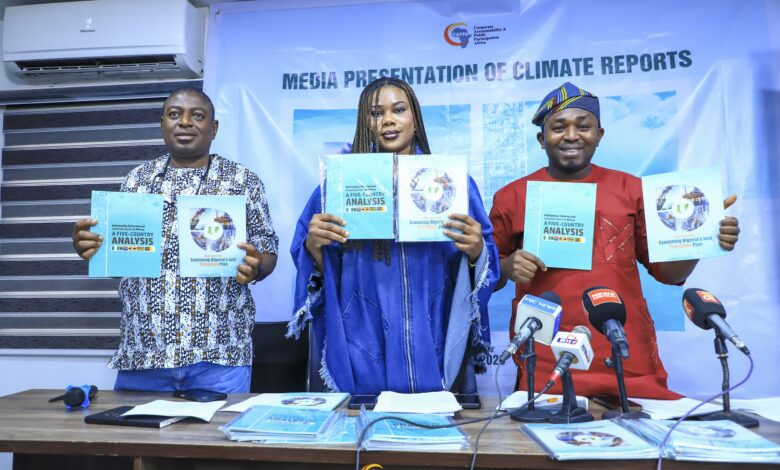
The media launch and dissemination of the reports took place on Tuesday, 10 November 2026, at Ogba, Lagos.
The two reports are ‘Four Years On Examining Nigeria’s Just Transition Plan, and Nationally Determined Contributions in Africa’ analysing five Africa countries.
The first report looks at Nigeria’s Energy Transition Plan while second report looks at the climate pledges of Nigeria, Cameroon, South Africa, Togo and Uganda. Together, they provide an assessment of their climate commitments, energy transition pathways, policy priorities, and approach to tackling the climate emergency.
CAPPA highlight what direction energy transition policies are taking in the countries studied, with a particular focus on implications for energy access, the environment, the public health system, economic growth, and the communities affected.
CAPPA’s Executive Director, Mr Akinbode Oluwafemi, in his opening remark stated that the reports came from a fundamental concern about whether climate policies are truly changing lives or only creating new profit opportunities. He asked, “Are Africa’s climate policies genuinely transforming our economies and protecting our people, or are they creating new opportunities for corporate interests to profit while communities bear the consequences?”
He explained why the question matters, pointing to the daily reality of floods, heat and drought across the continent. He said, “This question is important because Africa, like much of the Global South, contributes relatively little to the historical emissions driving climate change, yet bears a disproportionate share of its impacts. Somewhere on the continent right now, a mother may be waking up to find her home and shop submerged by flash floods, a farmer may be watching crops wither in extreme heat, or a pastoralist family may be struggling to survive after losing its entire herd to prolonged drought.”
However, to understand the reports, it helps to understand two simple terms. NDC which means Nationally Determined Contributions. It is each country’s promise to the world on how it will fight climate change. Every country that signed the Paris Agreement promised to cut the gases that heat the earth and to tell the world how it will do it. That promise is the NDC while ETP, which means Energy Transition Plan. For Nigeria, it is the plan to move from dirty energy, mainly oil, gas and petrol generators, to cleaner energy like solar, wind and hydro, without leaving people in darkness or without jobs. A Just Transition means that change must be fair. Workers must not just lose their jobs. Communities in the Niger Delta whose land has been damaged must get their environment restored. Poor families must still get cheap and reliable electricity.
CAPPA’s Associate Director, Olamide Martins, explained at the launch that the reports were produced to test whether these plans are really serving ordinary people, or mainly serving investors and oil companies. In his explanation, a plan that calls itself just and green must be judged by whether it improves lives, expands access to power, protects health and land, and creates secure livelihoods, not only by how good it looks at international meetings.
The findings, according to Mr Oluwafemi, reveal several uncomfortable truths that governments often avoid. He said, “Against this backdrop, these two reports reveal several uncomfortable truths that African governments too often leave unaddressed.”
The first uncomfortable truth, he said, is that governments are developing clean energy projects while also supporting the expansion of fossil fuel infrastructure. He said, “First, governments are developing clean energy projects while also supporting the expansion of fossil fuel infrastructure. In Uganda, for instance, French multinational TotalEnergies frequently highlights its global investments in renewables, including solar energy. Yet it is also a leading developer of the East African Crude Oil Pipeline (EACOP), which runs through Uganda and Tanzania, and the Tilenga oil project in Uganda.”
He added, “Meanwhile, despite its stated commitment to decarbonisation, Cameroon recently awarded five of the nine oil blocks offered to fossil fuel operators, including Murphy Oil and Octavia Energy.”
“Nigeria illustrates this tension. Our assessment recognises progress in policy development and renewable energy deployment but finds that cleaner energy is being layered onto an economy still heavily focused on oil and gas, without sufficient change in the institutions and revenue systems that sustain that dependence. The country’s net-zero ambition for 2060 sits alongside an official oil production goal of three million barrels per day by 2030, while Cameroon’s hydrocarbons corporation confirms five exploration blocks entering contract negotiations with Murphy West Africa and Octavia Energy.”
The statement also warned about gas. It said, “The promotion of gas as a clean bridge to the future deepens this contradiction. Methane, the principal component of natural gas, is a powerful greenhouse gas, and methane emissions from all sources account for nearly 30 per cent of warming since the Industrial Revolution.”
Mr Oluwafemi also raised concern about who is writing Africa’s climate policies. He said, “Equally concerning is the outsourcing of African climate policy development to foreign companies. Togo, for instance, engaged Cibola Partners, a Paris-based private carbon advisory firm, to prepare key technical deliverables for its climate mitigation, adaptation and investment planning. Such arrangements deserve interrogation because the institutions shaping our climate policies also influence whose interests those policies serve.”
He added, “Furthermore, fossil fuel companies are pushing gas and ‘carbon credit’ schemes to keep polluting, while pretending it is green action. An example is the Cross River State REDD+ Programme in Nigeria.”
On money, he warned that climate finance delivered as loans risks pushing African nations deeper into debt. He said, “Even worse, climate finance delivered as loans risks pushing African nations deeper into debt as they respond to a crisis they have contributed little to creating. Research published last year by Oxfam and the CARE Climate Justice Centre estimates that the roughly US$62 billion in climate loans received by developing countries in 2022 could generate up to US$88 billion in repayments over their lifetime, approximately seven dollars repaid for every five dollars received. These arrangements require countries already bearing disproportionate climate impacts to transfer further resources to wealthy creditor countries and institutions, compounding the injustice of the crisis.”
Zikora Ibe, the Assistant Executive Director, CAPPA, warned about land, saying rural communities risk losing ancestral lands to projects presented as green, especially where land rights are weak and affected people have little influence. He said, “Alongside these financial pressures, rural communities risk losing their ancestral lands to corporations pursuing projects presented as ‘green’, particularly where land rights are weak and affected people have little influence over decisions.”
She also said that the machinery for delivering justice remains weaker than the language promising it. It said, “Our Nigeria report also finds that the machinery for delivering justice remains weaker than the language promising it. Responsibilities are dispersed across institutions, financing relies heavily on anticipated investment, and workers and affected communities lack sufficiently enforceable guarantees of income security, retraining and environmental repair. With the World Bank reporting in March 2025 that more than 80 million Nigerians lack access to electricity, success must mean reliable, affordable power and secure livelihoods, alongside measurable emissions reductions.”
On carbon markets, the statement warned that offsetting allows buyers to claim compensation for emissions through projects elsewhere, but carbon stored in vegetation can be released again. It said, “When such arrangements become an excuse to postpone cuts at the source, responsibility shifts from polluters to the land and communities expected to absorb their emissions.”
It gave Uganda as an example. It said, “Uganda’s climate plan reflects these choices, assigning far greater projected emissions reductions to commercial plantations than to its two natural-forest restoration measures. The risks extend beyond accounting: the Oakland Institute documents forced evictions associated with a forestry and carbon-credit project in Kachung, Uganda. Climate action loses its moral foundation when protecting a carbon asset takes precedence over protecting the people who depend on the land.”
On financing, the statement said, “Nigeria estimates that its climate commitments require US$337 billion between 2026 and 2035, with 80 percent expected from international funding, while Togo makes 69.9 percent of its financing requirement conditional on international support. South Africa’s NDC reports that approximately 80 percent of the international financial support recorded for 2021-2022 comes as loans. When countries must borrow to confront damage they have done little to cause, climate finance risks transferring the cost of historical pollution to its victims.”
One of the strongest calls was directed at Africa Group of Negotiators presently at COP31. She said, “We therefore call on the African Group of Negotiators and progressive delegates at COP31 to reject carbon offsetting as a substitute for emissions reductions and challenge net-zero accounting and Article 6 arrangements that allow continued fossil fuel pollution to be balanced against temporary or unreliable carbon storage. This must be accompanied by policies that prioritise natural forests, biodiversity and community-led restoration, rather than rewarding commercial plantations at the expense of ecosystems, agroecology and food sovereignty.”
In simple language, Article 6 is the part of the Paris Agreement that allows countries and companies to trade carbon credits. The coalition is saying companies should not be allowed to keep polluting and then use paper credits from temporary tree planting to claim they are clean. Real cuts must happen at the source, at the oil well, the gas plant and the factory.
Zikora statement also called for binding safeguards against corporate capture, including conflict-of-interest rules to stop fossil fuel companies, major polluters and conflicted consultants from determining national climate priorities, and to ensure workers, civil society and affected communities have meaningful authority over decisions.
Partners from across Africa also spoke at the launch, including some who joined online. They included Mr Shuibu Abdullahi Muhammed, member of the Make Big Polluters Pay, MBPP, Ndivile Mokoena, Executive Director, YIM Foundation, South Africa, and Tijah Akpan.
Ndivile Mokoena said, “The persistent gap between global climate commitments and local realities raises critical questions about political will and economic systems that continue to prioritise profit and growth over human well-being and ecological sustainability. This report underscores the urgent need to move beyond promises to tangible implementation, adequate climate financing, and meaningful support for developing countries.”
Oluwafemi closed the launch with a call for scrutiny. He said, “We believe these contradictions deserve greater public scrutiny. A just transition must mean more than changing energy sources or announcing ambitious targets. It must improve people’s lives, protect livelihoods, respect community land rights, and ensure that those responsible for the climate crisis meet their obligations.”
He added, “Today, CAPPA and the Africa Make Big Polluters Pay Coalition place these reports before the African Group of Negotiators (AGN) and all progressive delegates to COP31. We also place them before the public and the media because we believe climate governance must be transparent, accountable and open to independent scrutiny.
“We hope their findings will stimulate informed debate, strengthen civil society advocacy and challenge governments to pursue climate policies that genuinely serve the public interest. I thank our partners, researchers, community representatives and colleagues whose contributions have made this work possible. I also thank the media for joining us. Your role in interrogating these findings and bringing their implications to public attention is indispensable.” Oluwafemi stated.