Newsbreak: Brittain heads toward break up
By Omolade Adegbuyi
Britain may be heading towards a split into at least three more nations. This comes as Scotland, Wales, Northern Ireland prepare to sign a joint declaration demanding self-determination.
There are considerations that the development may bolster self determination movements especially in British former colonies including Nigeria. Many of British former colonies like Malaysia, Sudan, India, are already split along ethnic lines. In Europe, there are some 38 countries with 38 languages and cultures. Some of the sovereign nations are as small as two local governments in Kaduna or Lagos.
The three nations of Scotland, Wales and Northern Ireland seeking to exit the United Kingdom hope to meet in Cardiff. The three-angle meeting is expected to lead to assertion of the right to self determination by the three nations. The Ministers representing the three regions are expected to sign a joint declaration that asserts their right to be sovereign nations out of the United Kingdom. The Ministers also demand t hold independence referendums. The General Secretary, Alliance for Yoruba Democratic Movement, (AYDM), a coalition of over 130 Pan Yoruba groups in chat with Irohinoodua said the group is ‘monitoring the developments with keen interest.’ According to him, self determination is the new song of the century. ‘Nigeria at the fullness of time will cave in to self determination. It’s a force, a movement no one can stop.’ He said no matter how prosperous a country may become, it does not stop the determination of ethnic groups to seek their own sovereignty adding that the strongest and most prosperous indigenous nations in the world are those where the language and culture are one or at least with a dominant, majority ethnic group.
The development is the United Kingdom is a clear indication that economic prosperity does not in itself eliminate the quest for self determination driven by civilisations, language, history, philosophy and spirituality. The Marxist theory had wrongly held the view that resolving class variables would lead to equality and stability. Developments across the world have proved otherwise.
The Scottish First Minister John Swinney (L) had given hint of the plan in a statement on the 2026 Programme for Government at Scottish Parliament on September 1, 2026 which took place in Edinburgh, Scotland.
According to The Telegraph, the planned declaration will extend to the economy, energy, relationship with Europe, internal cooperation, and self-determination.
Irohinoodua sourced that the three regions want to be allowed to European Union, (EU) which Britain earlier exited. Scotland and Wales wish to join as new members, while Northern Ireland is scheduled to be part of the Republic of Ireland.
The three also wish to strengthen ties with the European Union to help facilitate self determination.
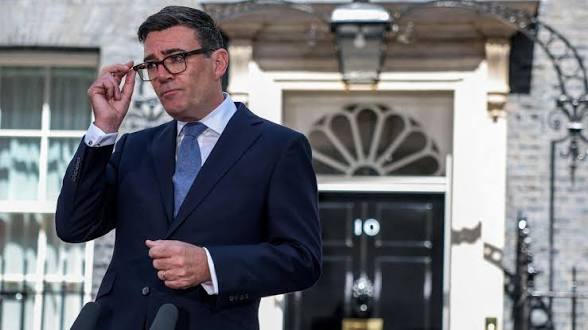
Sources told The Telegraph that the declaration aims to increase pressure on British Prime Minister Andy Burnham after he stated that a Scottish independence referendum could be held if it was backed by public support.
It was reported that last Thursday, Burnham courier a message to the Scottish National Party head and Scottish First Minister John Swinney, where he argued that a Scottish independence referendum would be “off limits” for now. But Swinney said public surge for the independence movement is “undeniable.” He Burnham “go down in history as the final prime minister of the United Kingdom.”
According to him “For the first time ever, Scotland, Wales and Northern Ireland are led by pro-independence first ministers. There could be no clearer sign that the status quo is not sustainable – and that Westminster must prepare for a post-UK future.”
Scotland, Wales and Ireland are part of the United Kingdom in an history that spans centuries due to conquest. Scotland history dates to hum settlement over 10,000 years ago, consisting of the Pictish and Gaelic kingdoms and ancient medieval monarchies. The war led to the Union with England in 1707.
On the part of Ireland, she became part of the United Kingdom on 1 January 1801 through the Acts of Union 1800. This union came into effect on 1 January 1801. Britain had nurtured the fears that an independent Ireland would join forces with then Revolutionary France. The Irish Parliament parliament was subsequently abolished for a centralised power under the UK Parliament in London. Wales on the other hand became part of the UK in 1536 through the Act of Union under Henry VII. Earlier, Wales had been taken over by the Crown in 1284.