SECRET MEMOIRS
“British creation of Nigeria was a big mistake. Smaller countries in better”
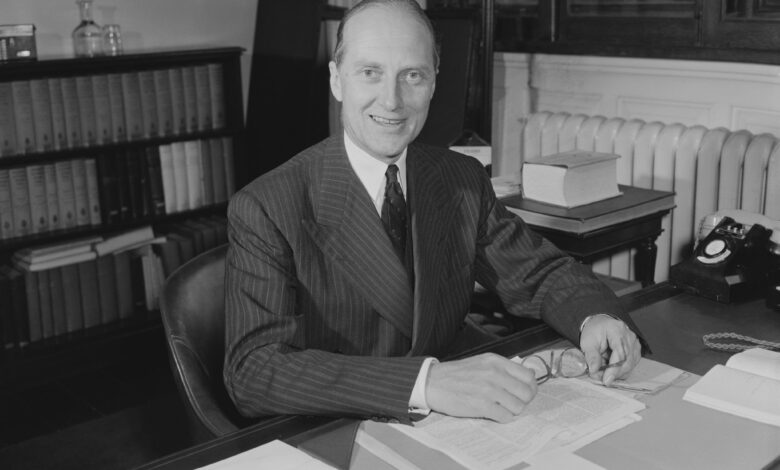
By Peters Smitters
Former private secretary in the Colonial Office, Lagos
I was Parliamentary Private Secretary at the Colonial Office through
almost the whole of the period of decolonisation, I was one of the three
man mission which visited Africa in 1952 to consider the federal structures
which it was proposed to establish in Africa, I was present at most of the
negotiations for independence including that of Nigeria, and I had the
pleasure of welcoming my friend Jaja Wachuku in New York when the Nigerian
delegation arrived there for the first time and I well remember the
magnificent speech made to the General Assembly, at which I was a UK
delegate, by President Abubakar. I had, therefore, a rather comprehensive
view of the process of decolonisation and of the establishment of Nigeria
in its present boundaries.
Unless my memory is at fault, Chief Enahoro stayed with me one weekend at
my house in Winchester, for which place I was then the Member of
Parliament, along with two of his colleagues.
The concept of Nigeria in the mind of Alan Lennox-Boyd, the Secretary of
State at that time (I was his Parliamentary Private Secretary and thus his
eyes and ears in the House of commons) was that Nigeria should be
established as a large and powerful state, rich in resources of many kinds,
which would be an element of stability amidst the numerous small African
states resulting from the dissolution of the French Empire. On the face
of it this was a reasonable view and I agreed with it at the time.
We
did not then have the benefit of experience generated by the problems of
multi-racial states which we have since seen manifested in the former USSR,
in Yugoslavia and elsewhere. It is now clear that the policy was
mistaken, and that it would have been better to set up a number of smaller
states corresponding with the pre-colonial ethnic boundaries.
At the
same time it must be pointed out that to have done this would have involved
the demolition of existing administrative structures, involving a good deal
of confusion and hardship at the very outset of independence. There
existed an excellent administrative machine ready for the new Nigerian
Government to take over.
What to do about this situation now is a matter of great complexity and I
shall not attempt to offer any solutions, but merely content myself with
saying that I entirely agree with Chief Enahoro in his assessment of the
root cause of the present problems.
The question really is whether it is
possible to find a suitable political structure for Nigeria within its
present boundaries.
I must however say that if your movement is to have any credulity it must
avoid propagating the ludicrous notion that the British were ‘ejected’ from
Nigeria or indeed from any of their colonies, and certainly not by my
former friend Chief Enahoro. The realities were quite different. At
the end of the War the world had changed, and it was recognised in the
Colonial Office that Britain had neither the means, nor, more importantly,
any interest in continuing to govern peoples who had arrived at a stage
where they were capable of governing themselves. There was no logical
foundation or political or ethical justification for a contination of
Empire. There was, therefore, a clear concept of withdrawal and the only
question arising concerned the structures which should be left behind and
the speed of the process. This depended greatly upon differing conditions
in differing Africal societies and was, not surprisingly, a matter of
controversy within individual colonies.
The attraction of the Kano rulers was that they had long and successful
experience of government.
N.B
Above is the secret e-mail from Sir Peter Smithers to Nigerian Review based in London meant for late Anthony Enahoro
NOTE THAT Peter Smithers pleaded the email should not be published but Nigerian Review eventually did publish the email revealing the root cause of most of Nigeran problems today