When the Imported Culture Becomes the Standard: Have We Lost Our Identity?

By John Abayomi Fakorede
In my previous article, “Hierarchy Disguised as Culture: You Cannot Import the Culture and Then Blame the Employee,” I reflected on the contradiction that arises when we import Western corporate practices and then suddenly invoke African tradition when those practices become uncomfortable.
Perhaps the issue goes much deeper than corporate culture.
Perhaps we need to ask ourselves a more fundamental question:
At what point did “Western” become synonymous with “right”, “modern” and “civilised” — while our own became something to apologise for?
Look around us.
Our definition of professional appearance, our languages, our food, our religious beliefs, our social etiquette and even our understanding of sophistication have all, to varying degrees, been measured against standards inherited from societies very different from ours.
There is nothing wrong with learning from other cultures. Civilisations have always borrowed from one another. The problem begins when cultural exchange becomes cultural surrender — when we stop asking whether an imported practice makes sense for us and begin assuming that it must be superior simply because it came from somewhere else.
Even our definition of “corporate” is imported.
Consider something as ordinary as going to work.
In much of corporate Nigeria, particularly in sectors such as banking, the suit and tie became the visual shorthand for professionalism.
Stop and think about it.
The modern business suit evolved in Europe, in a climate considerably colder than ours. Yet in Lagos, Abuja, Port Harcourt and other parts of Nigeria, where temperatures can be unforgiving, a worker may find himself dressed in layers of shirt, jacket and tie because that is what we have decided a “serious professional” should look like.
Why?
Why should a beautifully tailored Nigerian outfit be considered less corporate than a woollen or polyester suit?
What exactly makes one professional and the other merely “traditional”?
The distinction is not inherent in the clothing. It exists in our minds. We have inherited a definition of professionalism and continued applying it even where the environment that produced it is completely different from our own.
The legal profession provides an even more striking example. Nigerian barristers still appear ceremonially in wigs and gowns derived from English legal tradition.
The wig was not designed with Lagos humidity in mind. Yet generations after independence, we continue to associate this distinctly English form of dress with the solemnity and authority of the courtroom.
This is not necessarily an argument for throwing away every inherited institution.
Tradition — including inherited professional tradition — can acquire its own meaning over time.
But surely we should at least be capable of asking:
Does this still make sense for us? And perhaps more importantly:
Why are we sometimes reluctant even to ask the question?
When speaking your own language becomes a sign of inferiority.
The problem becomes more troubling when we move from clothing to language.
There are Nigerians who take pride in telling you:
“I can’t speak my language.”
Sometimes it is said almost as an accomplishment. Think about how extraordinary that is.
A Yoruba person unable to speak Yoruba, an Igbo person unable to speak Igbo, or a Nigerian whose ancestral language has effectively disappeared from the family within a generation may regard this not as a cultural loss, but almost as evidence of sophistication.
Meanwhile, people elsewhere devote enormous effort to preserving Welsh, Irish, Hebrew, Māori and other languages because they understand a fundamental truth:
Language is more than a means of communication. It carries memory, humour, philosophy, history and identity.
English is enormously valuable. It connects us internationally and, importantly, provides a common language in a country with hundreds of indigenous languages.
The argument is therefore not English versus Nigerian languages. We can have both.
A child capable of speaking excellent English and Yoruba has gained something. A child who must lose Yoruba in order to demonstrate proficiency in English has lost something.
Yet somehow we have allowed fluency in an indigenous Nigerian language to be associated in some circles with being “local”, while inability to speak that same language can be worn as a badge of cosmopolitanism.
That is not modernisation.
That is cultural insecurity.
And the irony is particularly striking when the person displaying this supposed sophistication has never travelled beyond Nigeria.
Religion presents an even more complicated legacy.What happened to our indigenous spirituality?
.
Christianity and Islam are now deeply embedded within Nigerian society, and for millions of Nigerians they are sincere, meaningful faiths. They are no longer simply “foreign religions” in any useful everyday sense; generations of Africans have made them part of their own spiritual lives. But that should not prevent us from confronting another historical reality.
Many indigenous African religious traditions were routinely characterised during the colonial and missionary periods as primitive, pagan, fetishistic or evil.
Whole systems of spirituality, morality, cosmology and community practice were frequently reduced to caricatures.
That legacy has consequences.
Even today, some Africans can discuss the mythology and ancient religions of Greece, Rome or Scandinavia with intellectual curiosity, yet react to indigenous African spirituality primarily with fear or contempt.
We should be able to distinguish between studying and respecting our cultural inheritance and personally practising a particular religion.
One does not have to worship an indigenous deity to recognise indigenous religious traditions as part of African history.
A society that cannot examine its ancestors without embarrassment has surrendered an important part of its memory.
Then there is food.
Increasingly, the language of healthy living can make traditional African food sound like something from which the modern professional must escape.
Suddenly we hear endlessly about salads, smoothies, imported grains and fashionable “superfoods”.
There is nothing wrong with eating salad.
There is nothing wrong with quinoa, avocado or any other nutritious food.
But Africa was not waiting for the modern wellness industry to discover vegetables.
Our traditional cuisines contain leafy vegetables, legumes, beans, whole grains, tubers, fruits, fish, seeds, nuts and fermented foods.
The sensible question is not whether food is African or Western. It is about ingredients, preparation, portion and nutritional balance.
Some traditional dishes can indeed be unhealthy when excessively oily, salty, sugary or consumed in inappropriate portions. But exactly the same is true of Western food.
A hamburger does not become nutritionally superior to moi-moi because one arrived wearing the label “modern”.
Nor does a bowl of lettuce automatically represent nutritional enlightenment.
We should improve our diets based on evidence, not cultural prestige.
Socialisation may be where the loss is greatest.
Perhaps the deepest transformation, however, is occurring in how we socialise our children.
Culture does not survive primarily in museums.
It survives around the dinner table.
It survives in greetings.
In names.
In proverbs.
In stories.
In language.
In how children relate to grandparents.
In what families celebrate and what they consider embarrassing.
When parents stop speaking their language to their children because they fear it will interfere with their English; when traditional names are treated as inconvenient while European names are considered easier or more sophisticated; when indigenous clothing becomes something reserved largely for weddings and cultural days, something fundamental is happening.
No colonial administrator needs to suppress the culture at that point.
We are doing the work ourselves. And perhaps that is the most troubling stage of cultural domination: when the external standard has been internalised so completely that nobody needs to impose it anymore. We begin policing ourselves.
This is not an argument against the West.That distinction is important.
Western civilisation has contributed enormously to science, medicine, law, political thought, technology, education and countless other areas from which Africa has benefited.
Rejecting something merely because it is Western would be every bit as intellectually lazy as accepting something merely because it is Western.
Cultures grow through interaction. Africa itself has never been culturally static.
The question is not whether we should borrow. The question is whether we still possess enough confidence to choose.
Take what works.
Adapt what needs adapting.
Discard what does not suit us.
Preserve what remains valuable in our own traditions. And create something appropriate to who we are now. That is what confident societies do.
Modernity does not require cultural surrender. Perhaps we have confused modernisation with Westernisation for too long. They are not the same thing.
Japan became one of the world’s most technologically advanced societies without deciding that being Japanese was an obstacle to modernity.
Other societies participate fully in the global economy while consciously protecting their languages, clothing, food, traditions and social identities.
Why should African modernity require Africans to become progressively less African?
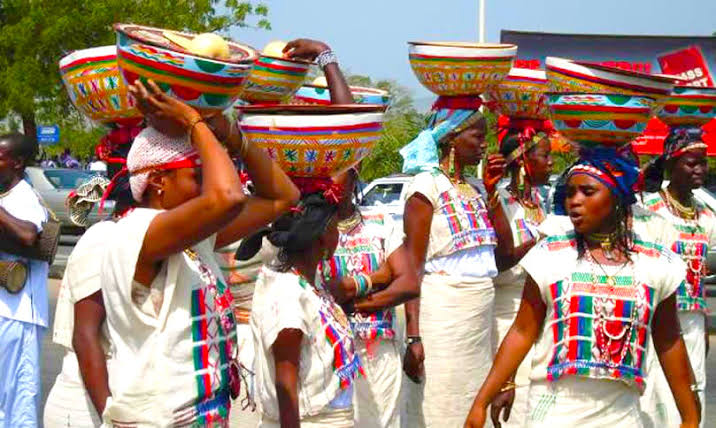
We can wear an African outfit into a boardroom and remain professional.
We can speak impeccable English and still speak Yoruba, Igbo, Hausa, Efik, Tiv or any of our other languages.
We can embrace modern medicine while preserving knowledge of our history.
We can practise Christianity or Islam without treating our pre-colonial ancestors as people without civilisation.
We can eat salad — and still recognise the nutritional value that exists within our own cuisines.
We can participate confidently in the modern world without becoming cultural copies of somebody else.
That, ultimately, is the connection with my earlier article. The problem is not simply that we import corporate culture.
The deeper problem begins when the imported culture becomes the standard against which we judge ourselves.
When their clothing becomes “corporate” and ours becomes “traditional”.
When their language signifies education and ours signifies backwardness.
When their customs become etiquette and ours become quaint.
When their historical traditions become heritage and ours become superstition.
When their food becomes wellness and ours requires rehabilitation.
At that point, we are dealing with something much bigger than cultural exchange.
We are dealing with the gradual erosion of the confidence required to define ourselves.
There is absolutely nothing wrong with learning from the West.
But there is something profoundly wrong when we must first become less ourselves in order to consider ourselves modern.
Perhaps the next stage of African development is therefore not simply economic or technological.
Perhaps it is psychological.
The confidence to look at the world, take what is useful, reject what is not, preserve what is ours, improve what needs improving — and stop assuming that something must be superior simply because it came from somewhere else.
Modernity should expand our choices, not erase our identity.